
Average Speaking Rate: How Many Words Per Minute Is Normal?
Speaking pace is easy to notice in other people and surprisingly hard to judge in yourself. You may feel calm while your audience hears a rush of words, or you may worry that you sound slow when your pace is actually clear and comfortable.
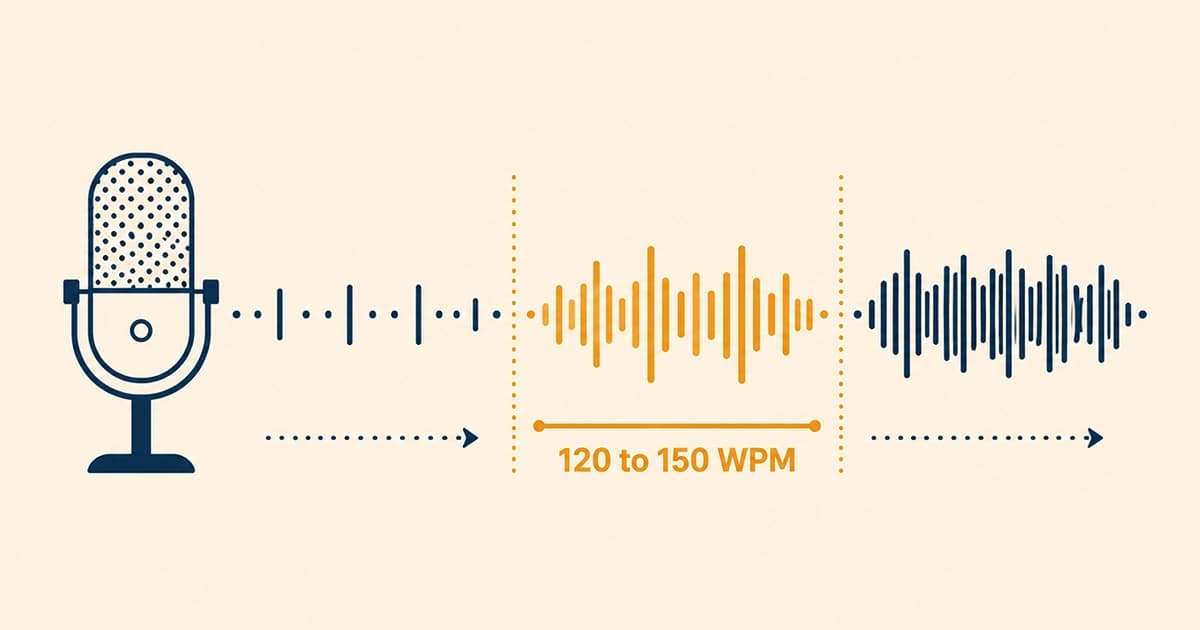
For many presentations and speeches, 120 to 150 words per minute is a useful starting range. It is quick enough to sound conversational but gives listeners time to follow the message. The best speaking rate is not one fixed number, though. It changes with your audience, subject, speaking style, and use of pauses.
This guide explains what words per minute means, how to calculate your own speaking rate, and how to adjust your pace without sounding forced.
The short answer
A normal public-speaking pace often falls around 120 to 150 words per minute. A broader range can still be effective. Microsoft's presentation guidance recommends 100 to 165 words per minute, while Toastmasters describes 120 to 160 words per minute as an effective range.
Treat those numbers as reference points, not a score you must hit. Clear pronunciation, useful pauses, and changes in pace matter more than staying at exactly the same speed for an entire talk.
Average speaking rate by situation
Different situations need different pacing. Explaining a technical process to a new audience usually requires more time than telling a familiar story. Use these ranges as planning guides and then test them with a real listener.
Below 100 WPM
Very deliberateUseful for emphasis or difficult material, but a full talk may feel slow.
100 to 120 WPM
MeasuredHelpful for technical explanations, instructions, and unfamiliar audiences.
120 to 150 WPM
Clear and conversationalA practical starting range for presentations, interviews, and speeches.
150 to 165 WPM
EnergeticCan work well for familiar topics, stories, podcasts, and lively delivery.
Above 165 WPM
FastMay still be clear, but check whether words, pauses, or key ideas are being lost.
These ranges align with guidance from Microsoft Speaker Coach and Toastmasters speaking guidance. Both also emphasize that speaking too quickly or too slowly can make a message harder to follow.
How to calculate your speaking rate
Words per minute, usually shortened to WPM, measures how many words you deliver during one minute of speech. The formula is simple:
Words spoken ÷ minutes spoken = words per minute
If you deliver 280 words in two minutes, divide 280 by 2. Your speaking rate is 140 WPM. If your recording lasts 90 seconds, convert that time to 1.5 minutes before dividing.
A reliable one-minute test
- Choose a topic you know well and record yourself for one minute.
- Speak naturally instead of reading or trying to reach a target.
- Transcribe the recording and count the words you actually said.
- Repeat the test twice and compare the results.
- Listen for clarity, pauses, and rushed phrases as well as the number.
A single average can hide important moments. You might begin at 130 WPM and jump to 190 WPM when you become nervous. Practicing with PitchBuddy's speaking feedback helps you review your pace alongside filler words, confidence, and delivery after a practice session.
Speaking rate is not the same as reading rate
Reading a prepared paragraph often produces a different number from speaking naturally. A script gives you every word in advance, so you do not need time to form the next thought. This can make reading sound faster, flatter, or less conversational than spontaneous speech.
Measure the activity you want to improve. Rehearse with your real slides and notes for a presentation. Answer an unscripted question for an interview. Read the actual script for a voice-over. The closer the test is to the real situation, the more useful your WPM result becomes.
How speaking rate changes your presentation length
Speaking rate connects directly to word count. Multiply your expected WPM by the number of minutes available to estimate how much material you can deliver.
Speaking rate × time limit = approximate word count
At 130 WPM, a five-minute talk contains approximately 650 spoken words. Pauses, slide changes, demonstrations, and audience reactions reduce that total. For a detailed breakdown, use our five-minute speech word-count and pace guide.
Signs you may be speaking too fast
- You run out of breath before finishing a sentence.
- Word endings become unclear or sentences blend together.
- Your important points have no space around them.
- You finish much earlier than you did during practice.
- Listeners frequently ask you to repeat information.
- Your pace rises sharply when you feel nervous or excited.
Fast speech can also create more fillers and restarts because your mouth reaches the next sentence before your thoughts are ready. If that happens during practice, see our guide on how to stop saying um and filler words.
Signs you may be speaking too slowly
- Pauses happen between individual words instead of complete ideas.
- Your voice stays at one speed and energy level for long stretches.
- Simple points take much longer to explain than necessary.
- You lose your place because the delivery has too little momentum.
- Your audience starts predicting the end of each sentence.
Slow does not automatically mean boring. A deliberate pace can create authority and give complex ideas room to land. The problem is a pace that stays slow even when the message needs energy or movement.
How to slow down without sounding unnatural
- Pause between ideas. Finish a complete thought, take a quiet beat, and then begin the next one.
- Mark your script. Add a slash where you want a short pause and a double slash before major transitions.
- Breathe before key points.A full breath lowers the urge to squeeze several sentences into one.
- Cut unnecessary material.If you are rushing to fit the time limit, edit the message instead of forcing yourself to deliver too much content.
- Emphasize important words.Giving one phrase extra weight naturally creates contrast and slows the surrounding sentence.
How to add energy if your pace feels too slow
- Practice complete phrases instead of delivering one word at a time.
- Become more familiar with the material so recall takes less effort.
- Use shorter sentences that are easier to say in one breath.
- Increase vocal variety before trying to increase raw speed.
- Record another attempt and check that clarity remains strong.
The best speakers change pace on purpose
An effective speaker does not hold one exact WPM from beginning to end. Pace works like emphasis. Slow down before an important conclusion, leave space after a surprising idea, and allow familiar stories to move with more energy.
Try this three-speed practice drill
- Choose a 60-second section of a presentation or interview answer.
- Deliver it once at your natural pace and record the result.
- Repeat it more slowly, using pauses to separate the main ideas.
- Repeat it with more energy while keeping every word clear.
- Listen back and choose the version that is easiest to follow.
The goal is not to manufacture a perfect number. It is to build enough control that you can adjust your pace when the audience, message, or moment requires it.
Frequently asked questions
What is the average speaking rate?
A practical starting range for clear public speaking is 120 to 150 words per minute. Some speakers remain clear outside that range, so your audience, subject, pauses, and delivery style matter more than hitting one exact number.
Is 150 words per minute too fast?
Not necessarily. A pace of 150 words per minute can sound energetic and clear when pronunciation is strong and the material is familiar. It may feel fast when the subject is technical or the audience needs more processing time.
How do I calculate my speaking rate?
Divide the number of words you spoke by the number of minutes you spoke. For example, 280 words delivered in two minutes equals 140 words per minute.
What is a good speaking rate for a presentation?
For many presentations, 120 to 150 words per minute is a useful starting range. Slow down for complex ideas and important conclusions, and allow your pace to rise slightly during familiar stories or energetic sections.